
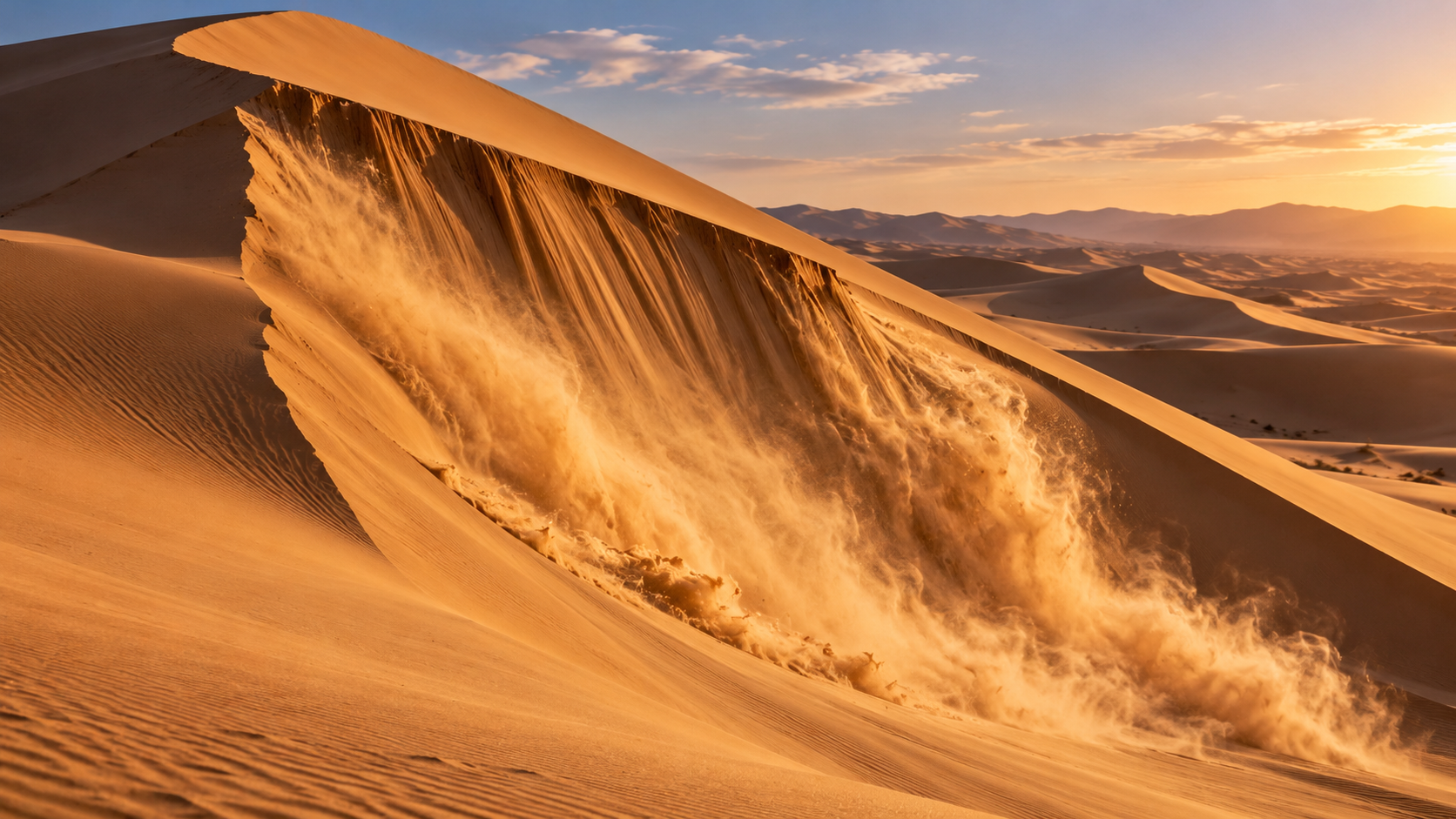
Some desert dunes make a sound you might expect from a distant aircraft or a very large musical instrument. When a sheet of dry sand slides down a slope, the dune can produce a low booming tone.
It isn’t the wind whistling through a hollow dune. The sound is closely tied to the movement of the sand itself, and researchers have spent decades investigating how it becomes loud enough to hear.
What does a singing dune sound like?
Reports describe sustained hums or booms during sand avalanches on certain large dunes. A 2007 Caltech field study recorded a strong dominant frequency between roughly 70 and 105 hertz, with higher harmonics. That’s a low-pitched sound, not a tune with changing notes.
Some events last for minutes. Others are short or do not happen at all. The phenomenon depends on local conditions; an ordinary sand pile at the beach is not guaranteed to sing.
It starts with sliding sand
A sand avalanche sends grains moving relative to one another. A 2006 Physical Review Letters study argued that moving grains can synchronize their motion and produce an audible frequency. Laboratory experiments showed that a full dune was not always required for the sound to arise.
That helps explain why scientists focus on moving grains rather than blaming open desert wind. The grains’ collective behavior is part of the instrument.
The dune can also act as an amplifier
The California Institute of Technology researchers found evidence that a layer of loose dry sand can act like a natural waveguide, supporting resonant sound. The depth and physical properties of that surface layer helped explain the frequency measured in the field.
These explanations address different parts of a complicated process: what makes grains oscillate together, and what carries or strengthens the sound through the dune. Research has not turned every booming dune into a perfectly identical acoustic machine.
Why don’t all dunes make noise?
Not all sand is arranged the same way. Grain conditions, surface-layer structure, moisture, and whether an avalanche occurs can affect the result. An Annual Review of Earth and Planetary Sciences paper described this booming phenomenon at dozens of sites and emphasized the importance of surface-layer resonance.
You also can’t hear what isn’t happening. A perfectly still dune may look identical to one that boomed yesterday.
The desert doesn’t need a speaker system
The striking part is that the sound comes from ordinary grains of sand, not a hidden cavern or secret mechanism. Under the right conditions, enough grains move in step for a vast slope of dry sediment to make an unmistakable noise.
For another geological trick hiding in plain sight, BiggleBit has covered the enormous underwater waterfall near Greenland. Nature is good at building phenomena that sound invented.
Sources: Caltech field study (2007); Physical Review Letters (2006); Annual Review of Earth and Planetary Sciences (2010).