
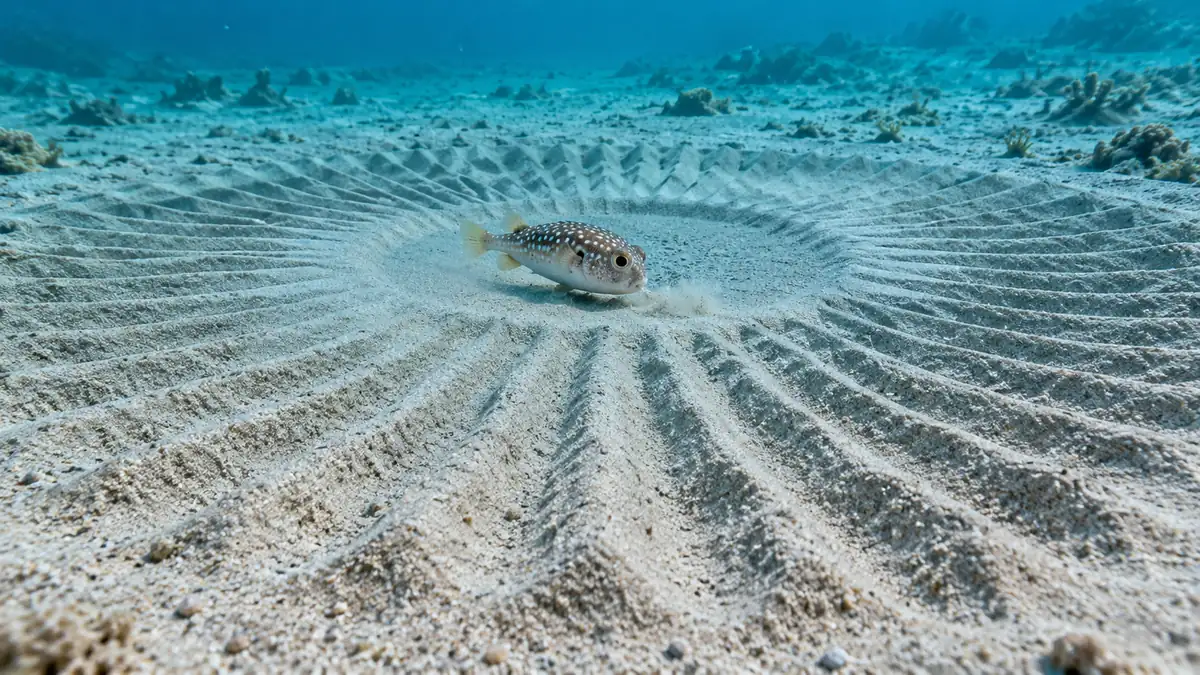
A tiny male pufferfish can spend days turning an ordinary patch of seafloor into something that looks like an underwater crop circle.
The fish is Torquigener albomaculosus, a small pufferfish found around Japan’s Amami-Oshima Island. Males are only about 10 centimeters long, yet they build elaborate circular sand structures roughly 2 meters across. That means the fish is making a nest around 20 times its own body length.
And no, the geometry is not a side hobby. The whole thing is part of courtship.
The pufferfish builds the circle by itself
Researchers studying the mysterious seabed circles found that a single male pufferfish creates the structure by repeatedly swimming across the sand and digging with its fins and body.
A 2013 study in Scientific Reports described the nest as a large geometric circle made of radially aligned peaks and valleys, with finer decorative patterns closer to the center. The male also gathers fine sand particles into the nest while constructing it.
For years, divers had seen these strange circles on the seabed without knowing what made them. The answer turned out not to be currents, geology, aliens, or a marine art collective. It was one very busy fish.
The circle is built to impress females
The researchers found that the structure plays an important role in reproduction and female mate choice. Females visit the finished nests, and spawning takes place in the central area.
The fine sand concentrated in the middle appears to matter too. In the 2013 work, researchers concluded that the nest’s geometry and its ability to gather fine particles were tied to female choice.
Later observations added more detail. A 2022 Scientific Data paper reported that males repeatedly construct these “mystery circles” during the breeding season, spawn with multiple females, and then care for the eggs alone until they hatch.
So the male’s dating strategy is basically: build an enormous geometric beachfront property, invite visitors over, and then become a single dad.
Simple digging rules create surprisingly precise geometry
The most impressive part may be that the fish does not need a tiny underwater ruler.
A 2018 Scientific Reports study analyzed how males excavate the outer ring. The fish repeatedly digs short, roughly straight paths from the outside toward the center. The researchers used those observed rules in a computer simulation and reproduced the same kind of radial pattern.
In other words, the complicated design can emerge from many repetitions of relatively simple actions. The fish does not need to mentally blueprint the entire circle before beginning.
The finished nest includes deep radial ditches in the outer region and a shallower maze-like pattern closer to the center. The 2018 researchers described the builder as roughly 10 centimeters long and the circle as roughly 2 meters in diameter.
The sand circle also moves fine particles toward the center
The structure is not just pretty.
The 2022 research reconstructed pufferfish nests in 3D and found that their shape can direct water through the grooves toward the center. The valleys also help move fine-grained sand particles inward.
That gives the circle a second layer of weirdness: it is simultaneously a courtship display, a nest, and a little piece of sand-moving engineering.
Researchers are still studying which specific features matter most to females, including the structure’s size, symmetry, ornaments and maze-like center. The evidence supports the general role of the nest in mate choice, but it would be too strong to say scientists have identified a single “perfect” circle that every female prefers.
And then he starts over
The male does not simply keep the same nest and spruce it up for the next date.
The 2013 study found that males did not reuse the nests. They built new circular structures for subsequent reproductive cycles, apparently because the old valleys no longer provided enough fine sand for the next round.
That is a spectacular amount of work for a fish small enough to fit in your hand.
BiggleBit already has an animal with three hearts and blue blood. The pufferfish contribution to the department of unnecessarily impressive biology is architecture.
A 10-centimeter fish building a 2-meter geometric mating arena on the ocean floor sounds like somebody made it up. The circles are real. The fish makes them. And apparently romance has been requiring ridiculous home-improvement projects for much longer than we thought.