
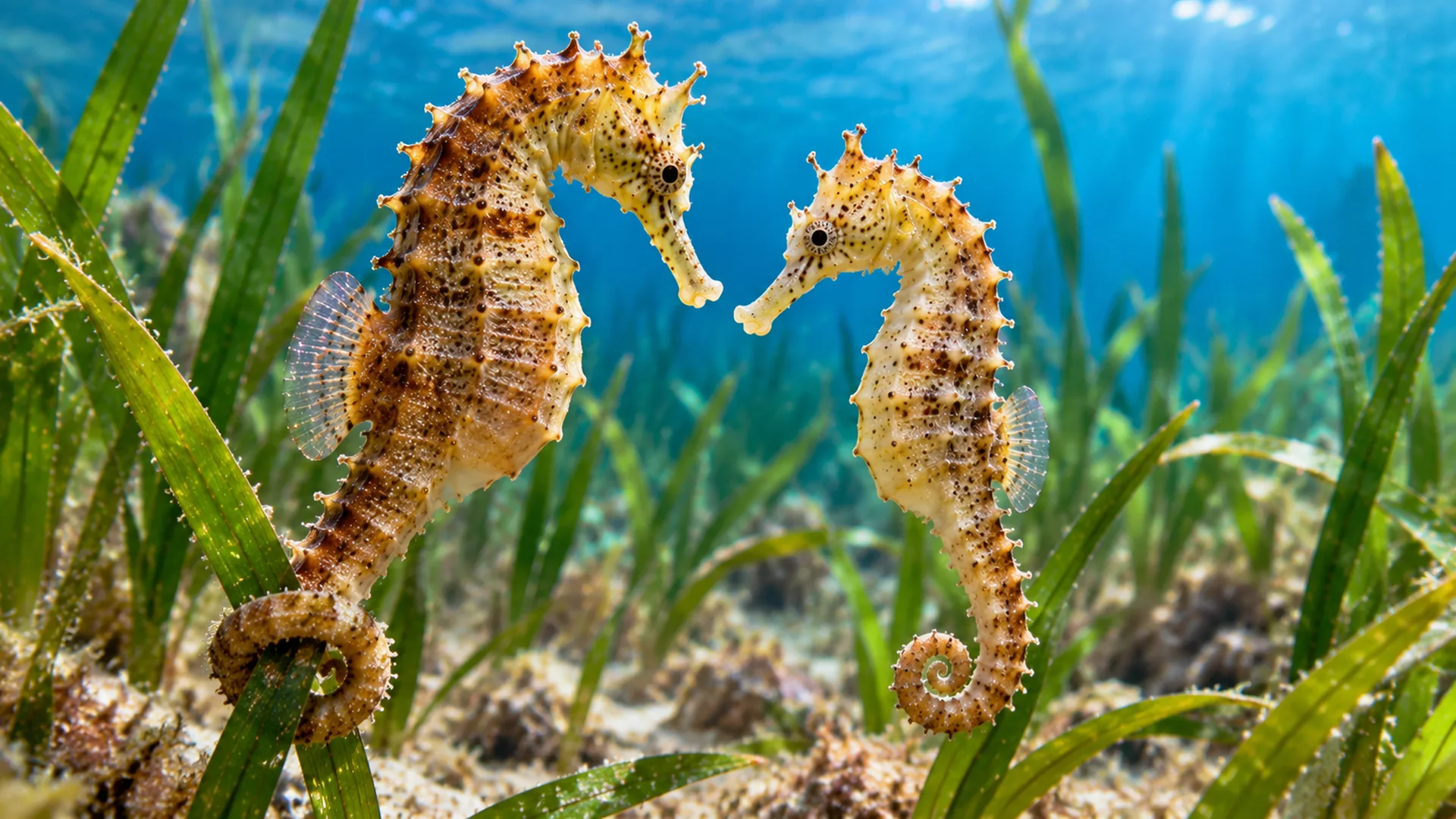
A male seahorse can spend weeks pregnant, then push a crowd of tiny, fully formed babies out of a pouch on his belly. This is not a mix-up about which parent is which. In seahorses, the dad really does carry the developing young and give birth.
The arrangement is unusual enough that the National Oceanic and Atmospheric Administration highlights male pregnancy as a defining feature of seahorses and their relatives. The female still makes the eggs. What happens next is where the parental job description gets interesting.
How does a male seahorse get pregnant?
Seahorse courtship can involve a carefully coordinated dance. When the pair is ready, the female transfers her eggs into a special brood pouch on the male’s abdomen. The male fertilizes the eggs there, and the embryos develop inside his pouch rather than being left exposed in open water.
So this is not a case of the male laying eggs or changing sex. The female produces the eggs; the male takes over the pregnancy. The Smithsonian Ocean Portal describes the brood pouch as a kangaroo-like structure, although seahorse reproductive biology is distinct from a mammal’s.
The pouch is more than an underwater backpack
The developing babies do not simply ride around until it is time to leave. In the lined seahorse, the Florida Museum of Natural History explains, blood vessels in the father’s brood pouch deliver oxygen, while the pouch provides a protected environment for the embryos. The embryos receive nutrition from their yolk sacs as they develop.
The length of pregnancy depends on the species and conditions. NOAA gives roughly two to four weeks as a common range. It is a remarkably compact process for something that includes fertilization, embryonic development and a delivery at the end.
What does seahorse birth look like?
It involves actual muscular contractions. As the embryos finish developing, the male’s abdomen begins to move rhythmically. The pouch opens, and the father forces the young into the surrounding water. The babies, called fry, are miniature seahorses ready to swim away.
A litter can range from a few dozen to hundreds of young, depending on the species and individual; NOAA notes that some births may release as many as 1,000. There is no hospital nursery waiting at the bottom of the reef. Once the fry are released, they must feed and evade predators for themselves.
Why do the males carry the babies?
There is no single tidy answer for why male pregnancy evolved in this group. What is clear is how the reproductive work is divided: females invest in producing eggs, while males provide the protected place in which the embryos develop. In some seahorse species, the arrangement lets pairs begin another reproductive cycle after a birth.
The key is not to confuse a possible evolutionary advantage with an established motive. Seahorses did not hold a meeting to reorganize childcare. Their unusual reproductive anatomy evolved over generations, and scientists continue studying how it works across different species.
They are fish with an already strange design
Pregnancy is not the only way seahorses depart from the standard fish silhouette. They swim upright, use a prehensile tail to grip seagrass or other supports, and have narrow tubular snouts that suck in tiny prey. They belong to the pipefish family, not to a secret branch of miniature ocean horses.
Marine biology has other improbable life-history tricks, including a jellyfish that can reverse part of its life cycle. But the seahorse’s version is especially concrete: the mother hands over the eggs, the father carries the pregnancy, and eventually the water fills with babies that look like tiny copies of their parents.
In a world where most fish leave eggs to develop outside their bodies, seahorses have made the brood pouch a family business—and dad handles delivery.