
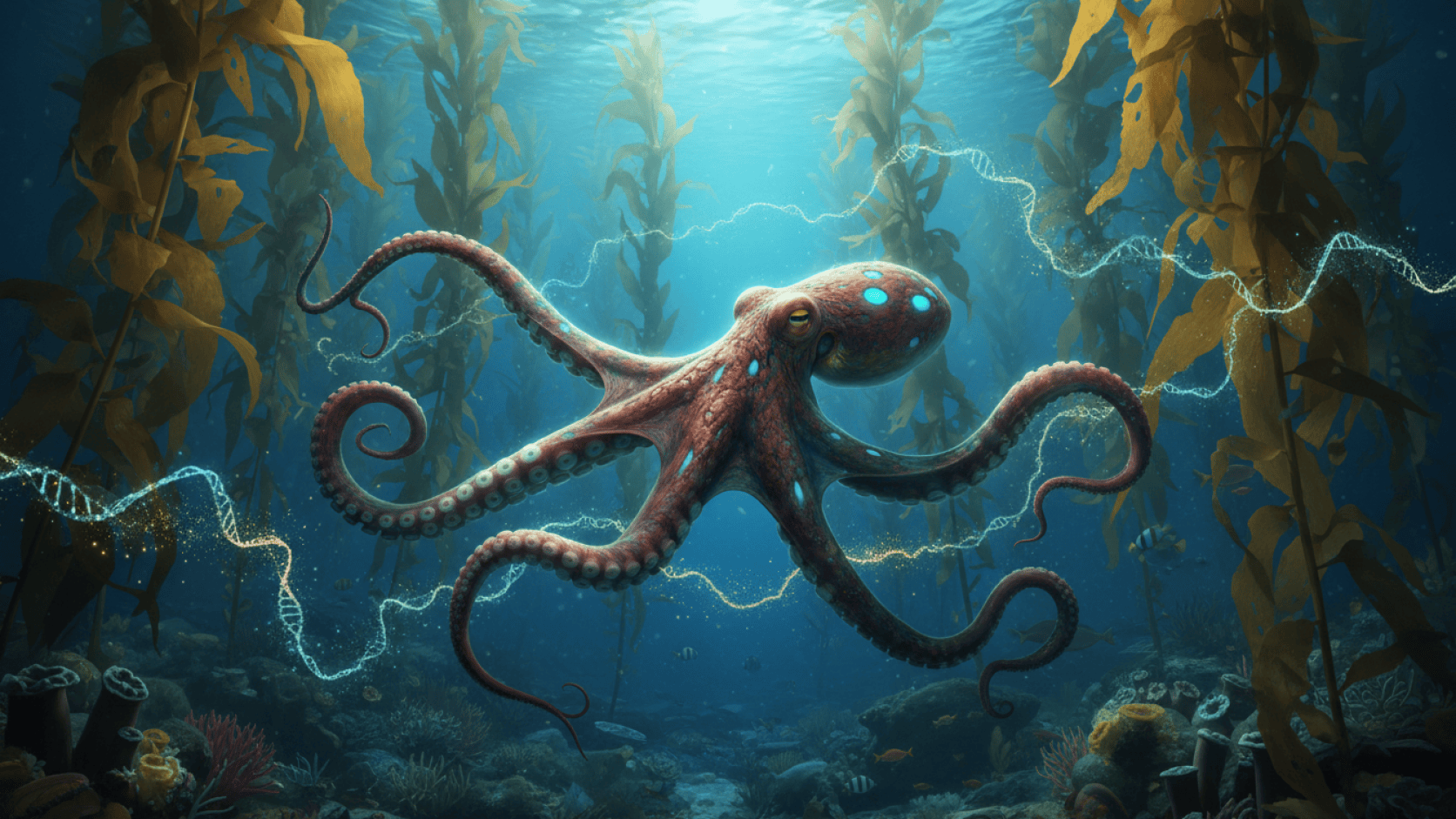
Octopuses can change how parts of their nervous systems work by editing RNA when water temperatures shift. In a 2023 study, researchers found thousands of temperature-sensitive editing sites that affected the instructions used to build proteins.
It’s not quite changing the genetic blueprint. Think of it as editing a working copy while keeping the original file.
The DNA stays put; the message changes
Cells use DNA as a source of instructions and RNA as part of the process that makes proteins. Certain enzymes can alter RNA after it has been copied from DNA, changing how the resulting protein is assembled.
Among cephalopods, this form of RNA editing is unusually extensive, especially in nervous-system tissues.
Cold water prompted major editing changes
In a 2023 Cell study, researchers examined California two-spot octopuses exposed to different temperatures. Editing patterns changed at thousands of sites, with many changes becoming more common in colder conditions.
The research team’s University of Chicago account reports that protein-altering RNA editing increased at 13,285 sites in the cold-water group, compared with 550 sites in the warm-water group. The study identified more than 13,000 affected codons in the neural proteome and investigated two temperature-sensitive proteins involved in nerve signaling and intracellular transport.
Those experiments found that editing could change protein behavior—not merely produce a different-looking sequence on a computer screen.
This can happen much faster than evolution
Genetic evolution across generations is one way animals adapt to their environments. RNA editing provides a different kind of flexibility: the animal can change how existing genetic instructions are used within its own lifetime.
A separate October 2026 Cell study examined longfin inshore squid, not the cold-water octopuses in the 2023 experiment. Researchers confirmed 7,997 RNA-edited sites in translated squid proteins and linked editing to changes in protein stability, location and activity. This strengthens evidence that cephalopod RNA editing can alter protein function, but it does not show that those particular squid changes were triggered by temperature.
In the controlled experiments, wild-caught octopuses first adjusted to ambient tank conditions for two to three weeks. Researchers then gradually shifted the water toward about 13°C (55°F) or 22°C (72°F), maintaining the target temperatures for another 12–24 days before tissue sampling. RNA editing began shifting within hours after a temperature change and stabilized after roughly four days. Seasonal samples of wild octopuses showed related changes. The researchers cautioned that the finding supports acclimation to gradual cooling, not a nervous system instantly retuned by a sudden dive into colder water.
Does that mean octopuses rewrite themselves at will?
No. The study shows a biological response associated with environmental conditions, not conscious editing or total control over the genome.
A Nature Genetics research highlight described this as a possible mechanism for adapting neural protein function to changing temperatures.
One more octopus surprise
BiggleBit already has a story about octopus suckers sensing chemicals by touch. This one happens on a far smaller scale, inside the molecular machinery of nerve cells.
For an octopus in colder water, the instruction manual doesn’t have to stay exactly as it was printed.