
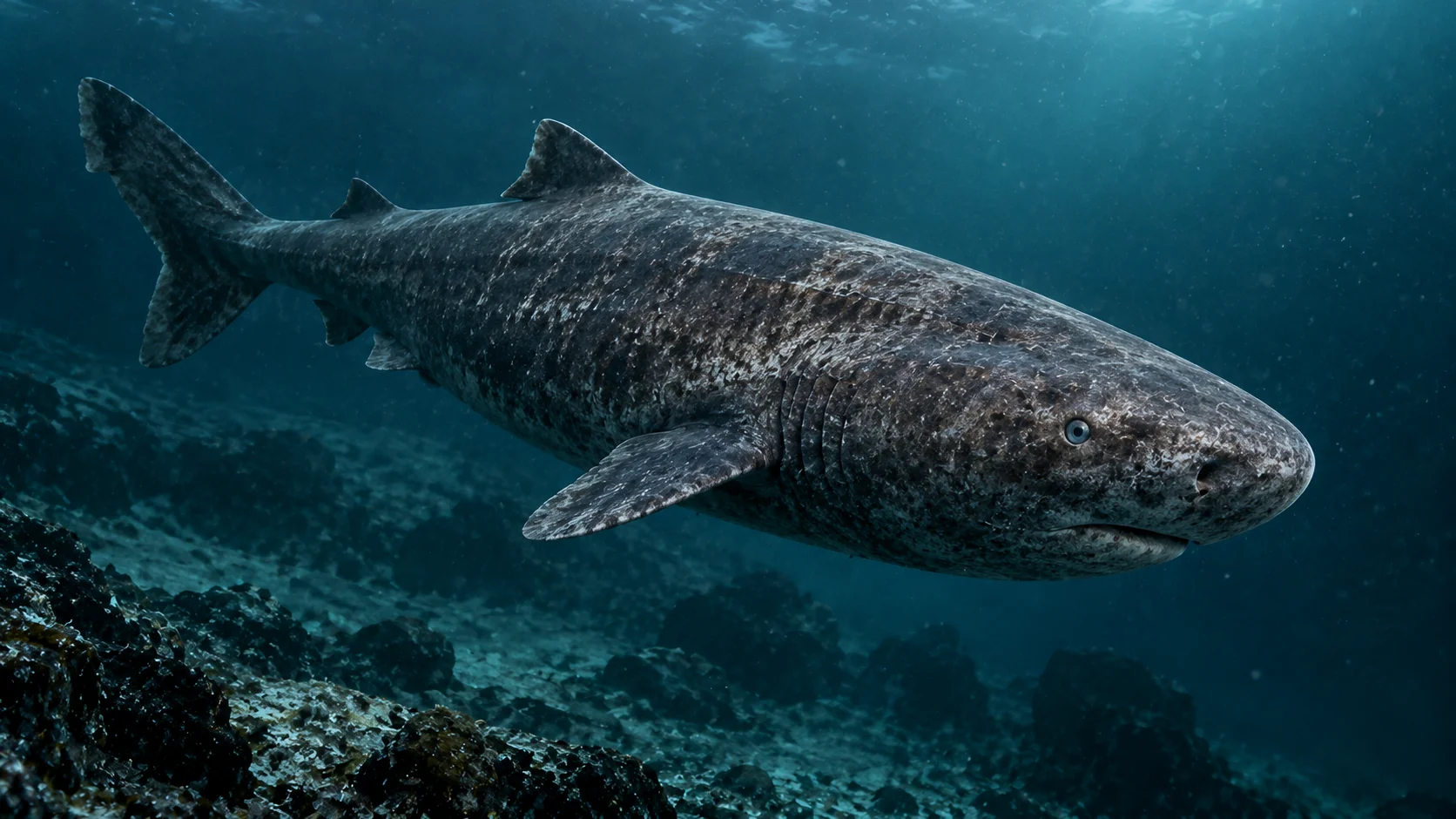
A Greenland shark could have been swimming through Arctic waters long before your great-grandparents were born. Scientists estimated one enormous female was roughly 392 years old. That’s extraordinary, but there’s a catch worth understanding: nobody knows her exact birthday.
The age came from chemistry preserved inside an eye lens, not from tracking a shark for centuries. The method suggests these slow-growing animals may live for hundreds of years, while leaving a surprisingly large margin for error.
The clues are inside an eye lens
In a 2016 study published in Science, researchers examined 28 female Greenland sharks ranging from 81 centimeters to just over five meters long. They measured radiocarbon in the inner parts of the animals’ eye lenses, tissue formed early in life that can preserve chemical clues long afterward.
The timing of atmospheric nuclear weapons tests helped them make sense of those clues. Testing raised carbon-14 levels during the mid-20th century, creating a recognizable marker in the food web. Only the smallest sharks in the study carried signs of that later carbon pulse. Larger animals appeared to have been born before it.
The team combined the radiocarbon evidence with a model relating body size and age. That produced an estimate for the largest shark: 392 years, plus or minus 120 years.
Four hundred years is an estimate, not a birthday
That plus-or-minus figure matters. The researchers’ reported 95.4% probability range for the largest shark stretched from roughly 272 to 512 years. It was a model-based estimate, not a calendar date proved by counting annual growth rings.
A 2025 Canadian government assessment makes the uncertainty explicit. The eye-lens work remains the only aging study of its kind for Greenland sharks, the age estimates have not been independently validated, and radiocarbon behavior in the deep ocean complicates the calculation.
None of that makes the results meaningless. It means the compelling scientific finding is evidence for exceptional longevity, while the familiar claim that a particular shark was exactly 400 years old goes further than the measurements allow.
Growing up could take more than a century
The same 2016 study estimated that female Greenland sharks may not reach sexual maturity until about 156 years of age, again with a wide uncertainty range. Even allowing for imperfect estimates, that’s a very slow timetable for replacing one generation with the next.
The Canadian assessment describes Greenland sharks being caught unintentionally in fisheries and warns that major gaps remain in population estimates. Long life does not automatically protect a species when each replacement can take so long.
The shark family itself has a much deeper past: shark ancestors were around before the first known trees. For an individual Greenland shark, though, surviving even a fraction of that evolutionary timescale is remarkable.
Their eyes have another surprise
The eye lens helped scientists estimate lifespan, but researchers have also investigated whether the rest of a Greenland shark’s visual system still works. A 2026 paper in Nature Communications reported intact retinal circuitry and molecular features suited to dim light, challenging assumptions that these deep-water sharks must have badly degraded vision.
That separate study did not confirm the age of the shark estimated at 392 years. It did add a fascinating detail to an animal scientists are still trying to understand. The strongest story here is big enough without pretending the uncertainty has disappeared: Greenland sharks may live on a timescale that spans human generations, and researchers are still figuring out exactly how long.