
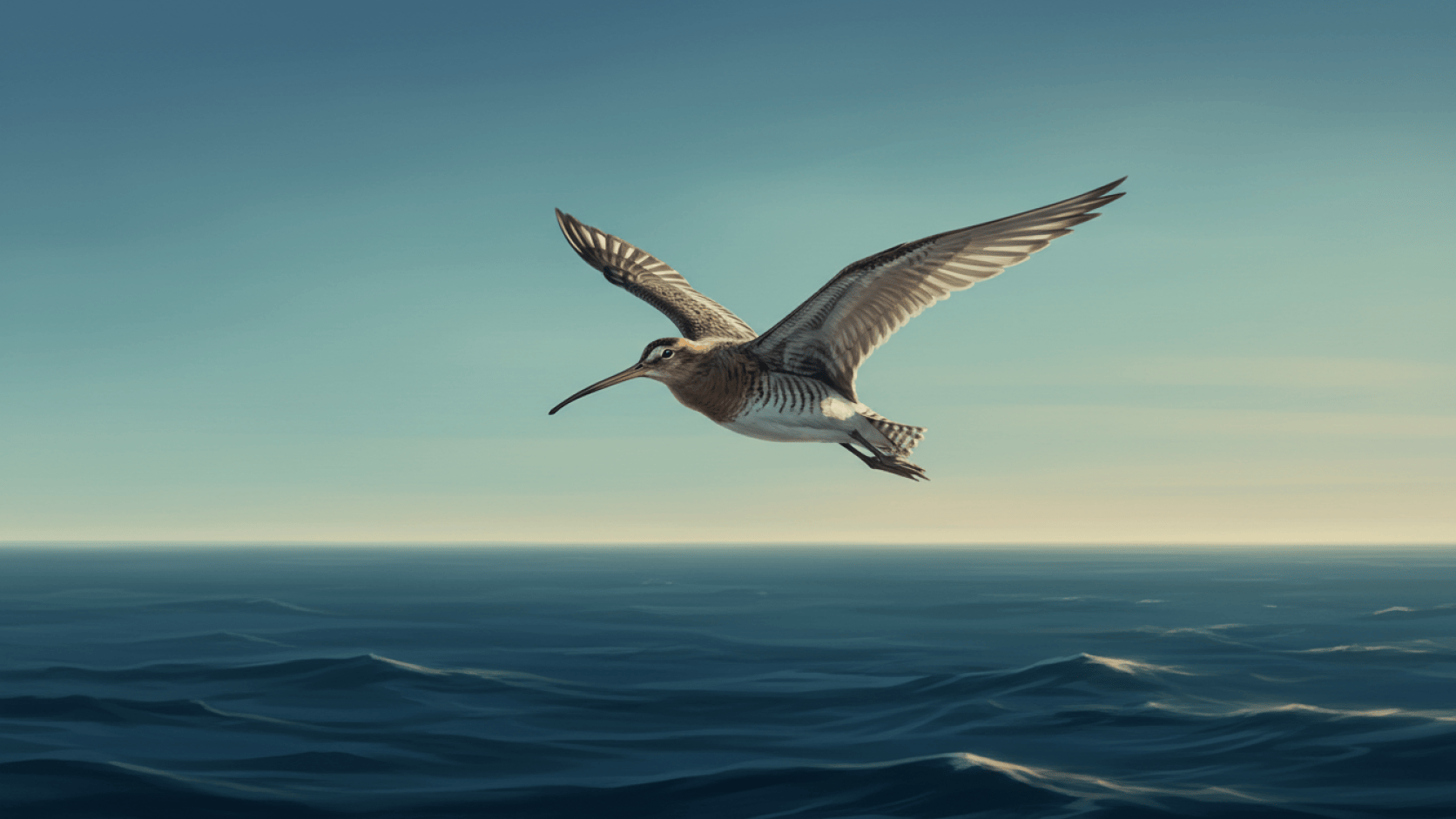
A young bar-tailed godwit flew about 8,425 miles from Alaska to Tasmania without landing. The satellite-tracked bird completed its journey in roughly 11 days in October 2022.
Some birds migrate a few miles. This one apparently looked at the Pacific Ocean and decided to cross an enormous stretch of it in one go.
A tiny tracker recorded an enormous journey
The shorebird, identified through its tracking tag as B6, was only a few months old. In the 2026 peer-reviewed study, researchers describe fitting three godwit chicks with 5-gram satellite transmitters to follow their movements and first migrations. One of those young birds was B6.
According to the U.S. Geological Survey’s 2022 account, B6 made a nonstop 11-day journey from Alaska to Tasmania, covering approximately 8,425 miles.
Guinness World Records lists the journey at 13,560 kilometers, or about 8,425 miles, for the longest documented nonstop migration by a bird in its published record.
A later peer-reviewed study by the USGS research team, published in 2026 in Wader Study, estimated the same juvenile’s flight at 13,391 kilometers (about 8,321 miles). That is a different scientific route-distance estimate, not a different bird or a reversal of the nonstop-flight finding. Researchers called the bird B6, from its leg flag; Guinness identifies its satellite tag as 234684.
Satellite tracking establishes that B6 stayed airborne, but it does not reveal whether the bird slept during those 11 days. A 2016 brain-recording study showed that great frigatebirds can sleep in flight; B6 was not monitored with that kind of equipment.
How can a bird fly for that long?
Godwits prepare for migration by building up substantial fat stores. Their bodies can shift resources toward the muscles and fuel needed for flight, while some other organs become smaller.
Those adaptations help explain how a bird can keep flying while unable to stop at a feeding site halfway across the ocean.
But the flight is still risky. An unsuccessful route over open water offers few convenient places for an emergency landing.
The route is part of an annual cycle
Bar-tailed godwits breed in northern regions, including Alaska, and travel to faraway nonbreeding grounds. Different populations and individuals use different routes.
B6’s documented crossing is an exceptional recorded journey, not a claim that every godwit flies the same distance or follows exactly that route every year.
One bird, a very large sky
Technology made the achievement measurable. Without the transmitter, this extraordinary flight could have happened almost entirely out of human sight.
For a different bird flight surprise, BiggleBit has covered how hummingbirds fly backward. Godwits solve a different flying problem: continuing forward for days at a time.
At the end of its first great migration, B6 had completed the kind of trip that makes a long-haul flight feel embarrassingly short.