
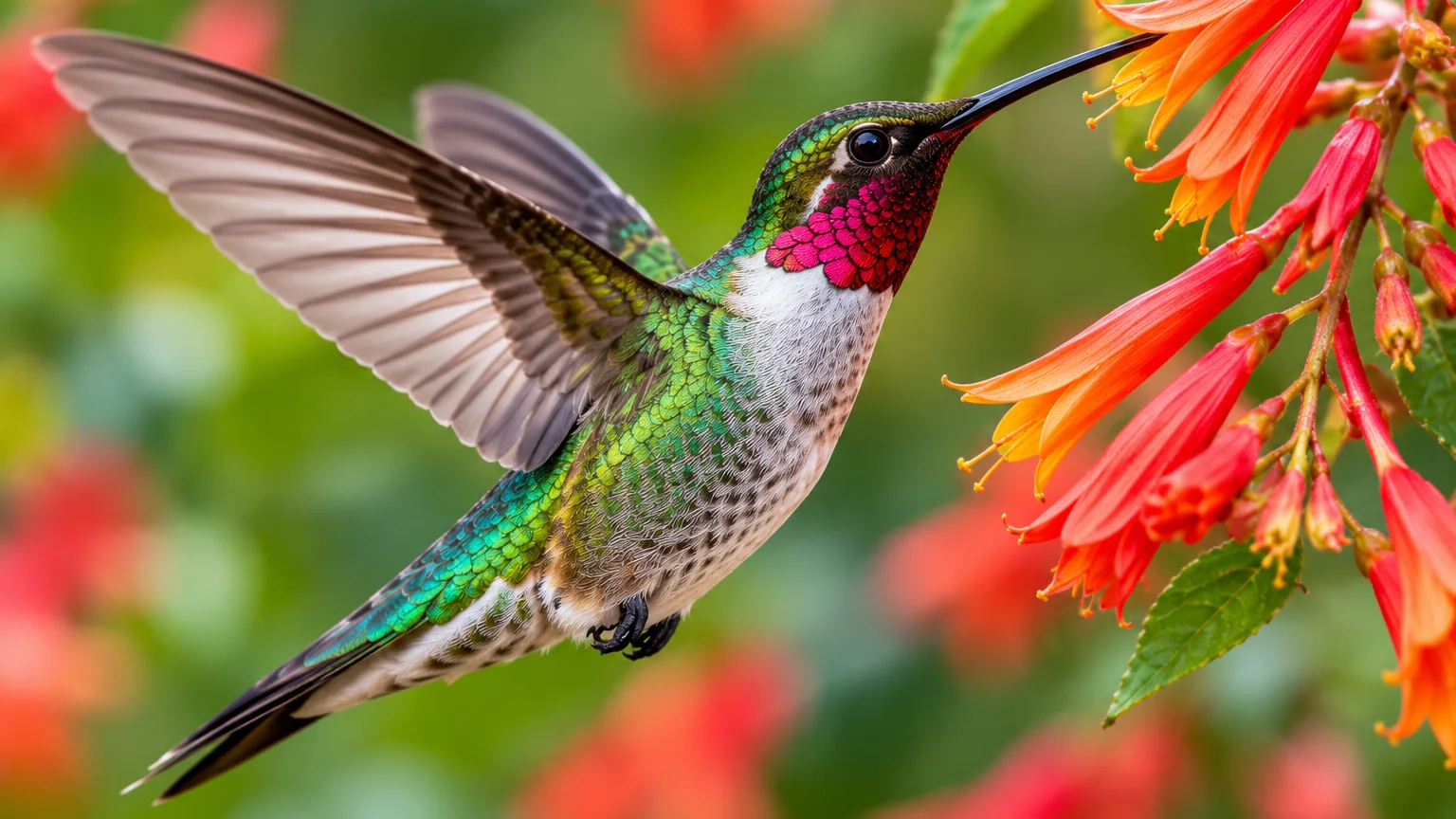
A hummingbird can fly backward. It can also hover in place and shift sideways, which makes the bird look less like an ordinary flyer and more like a tiny helicopter that never received a noise complaint.
Rotating wings create lift in both strokes
Most birds generate much of their lift during the downstroke. Hummingbirds have a different wing motion: the wings rotate through each beat, helping generate lift on both the forward and backward portions of their stroke.
Smithsonian Gardens describes how that movement allows hummingbirds to hold position at flowers while feeding. The bird does not need a branch beneath it to stay in one place. It can hang in the air while reaching nectar with its bill and tongue.
Backward flight is useful because a hummingbird can withdraw from a flower without first turning its entire body around. It is a small maneuver, but in a busy patch of blossoms, precise control matters.
Why reverse flight takes precise control
That control is not free. Hovering requires energy, and hummingbirds rely heavily on energy-rich nectar. They also consume small arthropods, which contribute nutrients beyond sugar. A bird that burns fuel quickly needs a reliable way to refuel.
The rapid wingbeats create the humming sound behind the birds’ name. Different species beat their wings at different rates, so a single number cannot describe every hummingbird in every flight condition.
For the primary evidence, see Smithsonian Gardens.
Backing away from a flower
Hummingbirds also use their aerial control in chases and territorial disputes. Hovering is not simply a decorative skill for people watching at feeders. It is part of how the birds navigate and compete in their environments.
Their flight has inspired engineers interested in small flying machines, but biology has had an enormous head start on the problem. The engineering lesson is about changing wing angle and managing lift, not copying a bird-shaped silhouette.
A hummingbird backing away from a flower is an everyday movement for the bird. For almost everything else with feathers, it is a reminder that flight comes in more than one design.
Hovering versus reversing: where the force goes
Hovering and moving backward are related skills, but they are not identical. To hover, the bird balances the forces acting on its body closely enough to remain in place. To move backward, it changes how those forces are directed. Its wings keep moving rapidly while the body travels away from the flower.
The wing does not operate like a rigid airplane wing. It twists and changes orientation during each stroke, helping control lift and direction. That is why simply counting wingbeats cannot explain the maneuver: the path and angle of the wings matter too.
Feeding makes this control useful. Flowers are often crowded among leaves and stems, and a hummingbird may need to approach, hold its position and withdraw without colliding with the surrounding vegetation. The movements look effortless, but they require precise coordination.
Flight behavior also varies among hummingbird species and situations. Not every individual performs every maneuver in exactly the same way, and the details of wing motion change with air conditions and the task at hand.
For a different example of bird specialization, crows can remember human faces. One bird’s remarkable skill is aerial control; another’s is recognizing who it has encountered.