
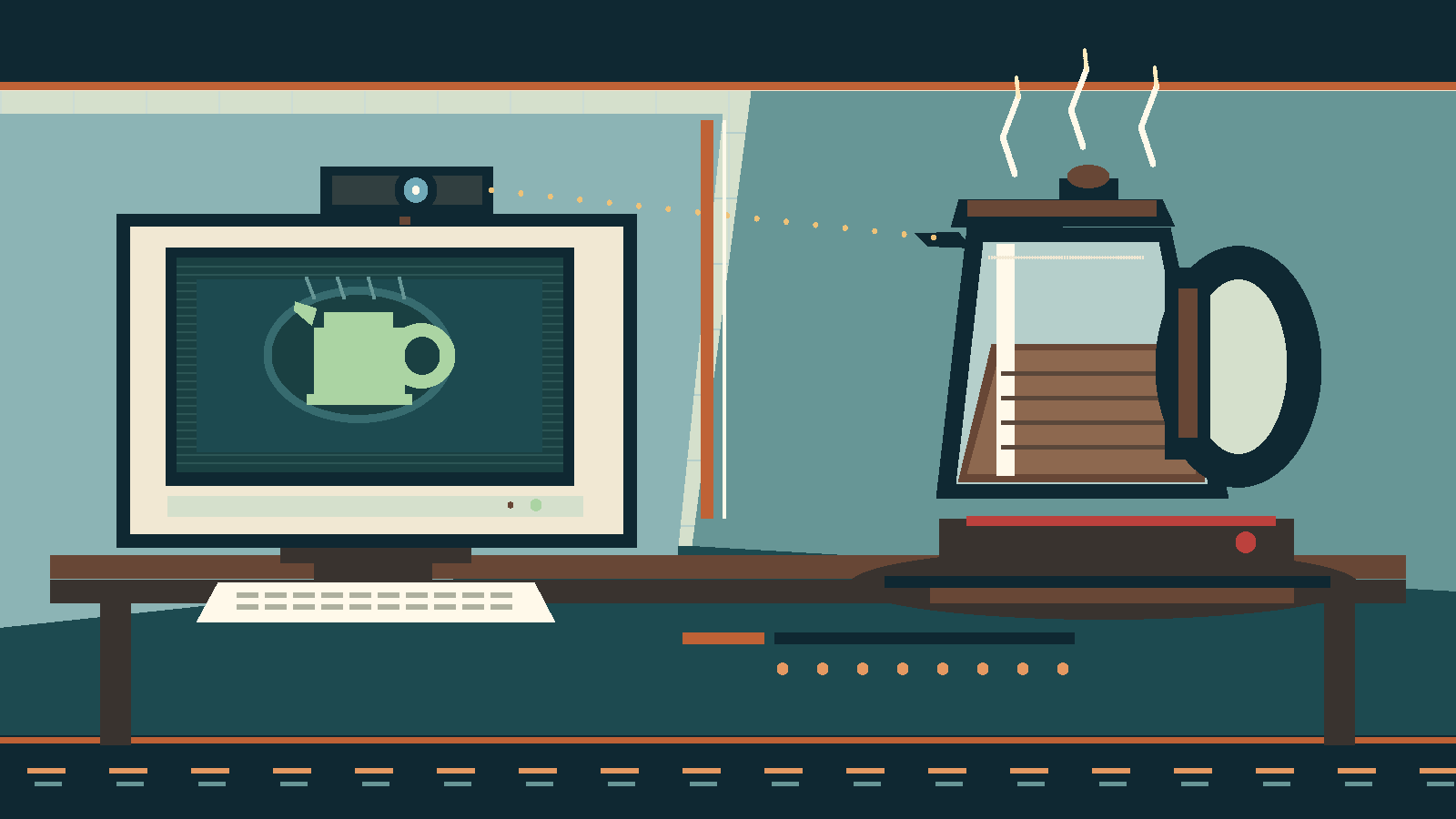
The first famous webcam wasn’t watching a celebrity, a landmark or someone’s front door. It was watching coffee. In 1991, researchers at the University of Cambridge set up a camera so they could check whether the shared pot was worth walking over to. The internet would eventually turn that extremely practical act of laziness into a worldwide attraction.
There is one important timeline wrinkle: the camera started on the laboratory’s internal network. It did not appear on the World Wide Web until 1993. The coffee came first; the “web” part arrived later.
A very Cambridge kind of office problem
At the University’s Computer Laboratory, the coffee machine sat in the Trojan Room. Researchers elsewhere in the building could make the trip only to discover that someone had already finished the pot. That’s not a global emergency, but it is a perfectly good reason to write some code before your second cup.
Computer scientists Quentin Stafford-Fraser and Paul Jardetzky mounted a camera on a laboratory retort stand and ran its wires under the floor to a spare frame grabber. Their XCoffee system fed small, grayscale images across the lab’s internal network. Jardetzky wrote the server software; Stafford-Fraser wrote the desktop client, called XCoffee. The tiny picture refreshed about three times a minute. As Stafford-Fraser recalls in his firsthand history of the setup, that was quite fast enough for a pot of coffee. The original system solved a local problem, not a plan to launch a video platform.
It even had a paper trail before it had a Web address. According to Stafford-Fraser’s first-person account, computer-network pioneer Bob Metcalfe described XCoffee in a January 27, 1992 trade-publication column after visiting the lab. The coffee camera was already a minor computing curiosity while it was still just a private-network convenience.
Gonville & Caius College’s account of the project places the setup in 1991 and describes how the experiment escaped the building two years later.
The Web gets an update nobody requested
In November 1993, Daniel Gordon adapted the original system to respond to Web requests and, with Martyn Johnson, made the Trojan Room coffee-pot images accessible through the World Wide Web. Gonville & Caius College dates the first Web images to November 22, 1993. Stafford-Fraser’s original project timeline distinguishes their Web work from the 1991 local camera. At a time when online pictures were still a novelty, a periodically changing view of an ordinary machine was strangely compelling. Viewers did not need an invitation to the Cambridge laboratory to check the coffee situation.
They could watch from anywhere with a web connection. According to the University’s account, the feed drew international attention, including visitors who wanted to see the real pot. The sight was less dramatic than a moon landing, but at least you knew whether the researchers had made another batch.
So was it a livestream?
Not in the modern, continuous-video sense. Early users saw refreshed still images, not the smooth live video familiar from calls and streaming platforms today. Its achievement was making an updated view of a real-world object available over a computer network and, later, the Web.
That distinction is worth keeping: the 1991 internal camera, the 1993 web-accessible images and today’s webcams are part of the same history, but they are not identical technologies.
The coffee joke even made it into internet protocol history. On April 1, 1998, Larry Masinter published RFC 2324, the Hyper Text Coffee Pot Control Protocol, a deliberately humorous proposal for commanding networked coffee makers. It included the now-famous 418 I’m a teapot response code and explicitly mentioned the Cambridge Coffee Pot. This was an April Fools’ document, not software that ran the Trojan Room camera. The original webcam watched a pot; the joke imagined a web that could make it brew.
The coffee machine eventually clocked out
The camera was switched off on August 22, 2001, as the lab prepared to move. The longest-serving coffee machine itself had an unexpectedly long afterlife: it sold for £3,350 at auction and eventually went on display at Germany’s Heinz Nixdorf MuseumsForum, according to Stafford-Fraser’s project recollections. The British Film Institute’s film about the Trojan Room Coffee Pot, made with original team member Stafford-Fraser, revisits the experiment using surviving historical images.
It is a lovely reminder of how much web history began with ordinary people trying to solve ordinary annoyances. For another kitchen object with an unexpectedly inventive backstory, there’s the moka pot’s connection to laundry machinery.
The coffee pot never asked to be famous. It just needed refilling.