
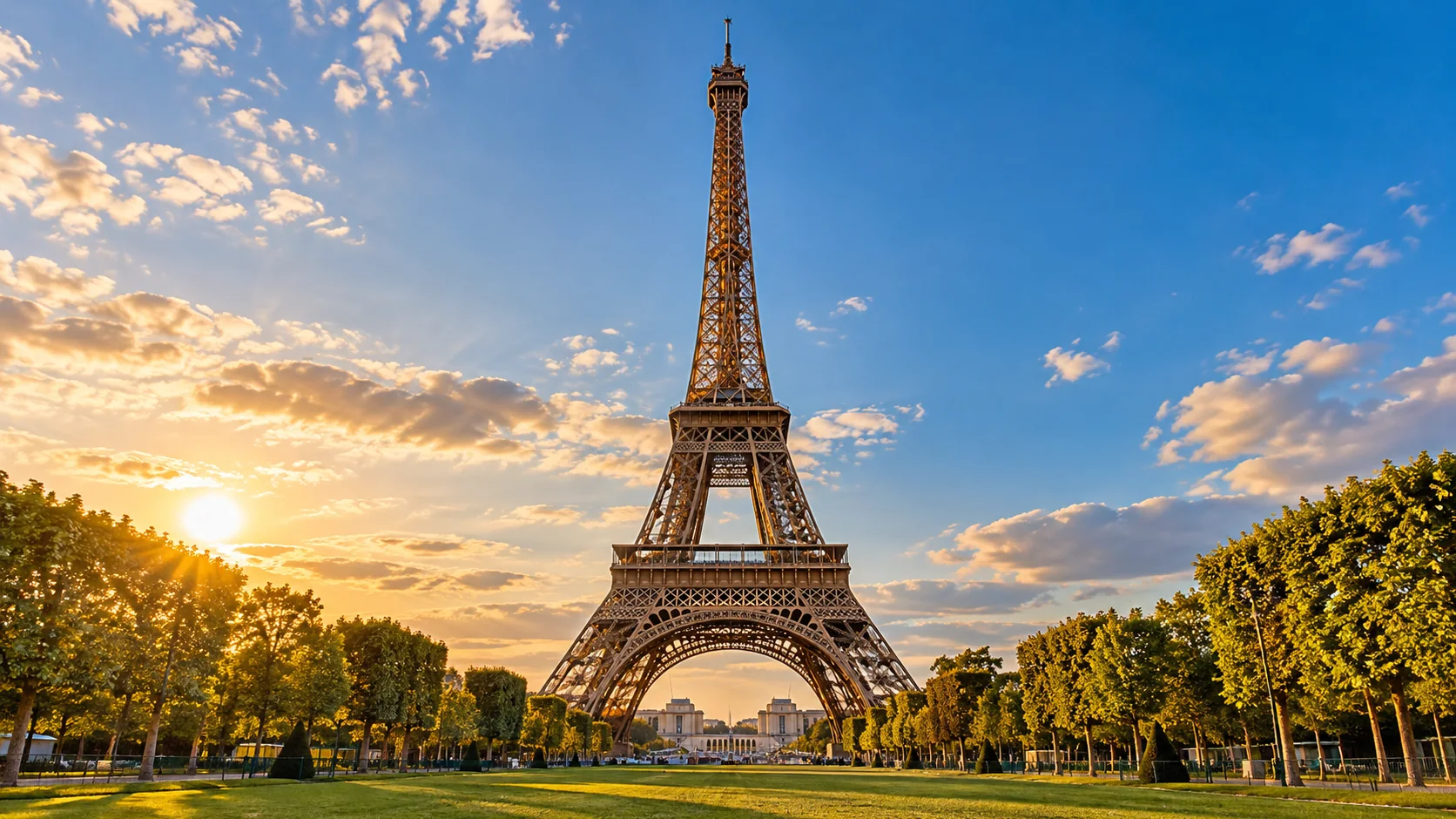
The Eiffel Tower gets a little taller when it gets hot. It also leans ever so slightly away from the sun. Paris has a world-famous landmark that spends sunny days expanding and shifting around, which seems like information someone should tell the postcards.
The explanation is real physics: the iron structure responds to changes in temperature. But there is a catch to the widely shared claim that the Eiffel Tower simply grows six inches taller in summer. That famous measurement has more than one interpretation, and the Tower’s own account makes an important distinction.
Why the Eiffel Tower grows when it’s hot
Metal expands as it warms up. Its atoms move more energetically, and the distance between them increases slightly. Multiply a small change over an enormous iron structure and the result becomes measurable.
The Eiffel Tower’s official website says its puddled-iron framework gains a few millimeters in height in warmer conditions, then contracts by a few millimeters as winter temperatures fall. The growth is temporary, not an architectural upgrade or an ongoing campaign to reach the clouds.
And yes, the material matters. The landmark was built from puddled iron, not the modern construction steel many people assume. Purdue University’s materials-engineering page identifies that iron and describes the structure as an example of thermal expansion.
So what about the famous six inches?
Here is where the viral fact gets slippery. About 15 centimeters is indeed a real figure associated with the Tower’s response to the sun. But the Tower’s own explanation of that measurement describes the path traced by its top over a sunny day, not simply 15 centimeters added straight upward to its height.
Sunlight heats one face of the lattice more than the others. That side expands a little more, and the structure leans away from the sun. As the sun moves across the sky, the tip can trace a roughly circular path about 15 centimeters, or six inches, across.
Some educational explainers, including Purdue’s materials-engineering page, also use 15 centimeters to describe expansion between hot and cold conditions. The sources do not express the vertical change in the same way: the Tower’s own account says a few millimeters of seasonal height variation and explicitly assigns the 15-centimeter circle to lateral movement. So it is safer to say the Tower changes dimensions and bends slightly with sunlight than to promise a six-inch vertical growth spurt every summer.
Can anyone actually see the Tower moving?
Not by staring up from the lawn and hoping for a dramatic wobble. The official site says the thermal movements are imperceptible to visitors. The Tower is not rubber, and its legs are not taking a stroll across Paris.
Wind creates another kind of movement, causing vibration or sway. The engineers behind the Tower had extensive experience building metal viaducts, and the structure was designed with wind in mind. In severe conditions, the top—or even the entire monument—can be closed for visitor safety. A little ordinary thermal expansion is not a sign the landmark is coming apart.
The Tower has grown for a completely different reason, too
Its measurable height has changed over the decades because equipment was added to the summit. The Tower’s official history says the structure measured 312 meters when inaugurated in 1889 and stands at 330 meters including its antennas, with additions in 1957, 2000 and 2022. That is lasting hardware, not summer heat.
The wonderfully odd takeaway is smaller and better than the meme: the Eiffel Tower has a temperature-sensitive skeleton, and on a sunny day its tip shifts position because sunlight does not heat all four sides equally.
For a far stranger response to winter, BiggleBit has also covered wood frogs that survive being frozen. The Tower’s seasonal trick is considerably less dramatic. Iron gets warm, iron expands, and Paris carries on.