
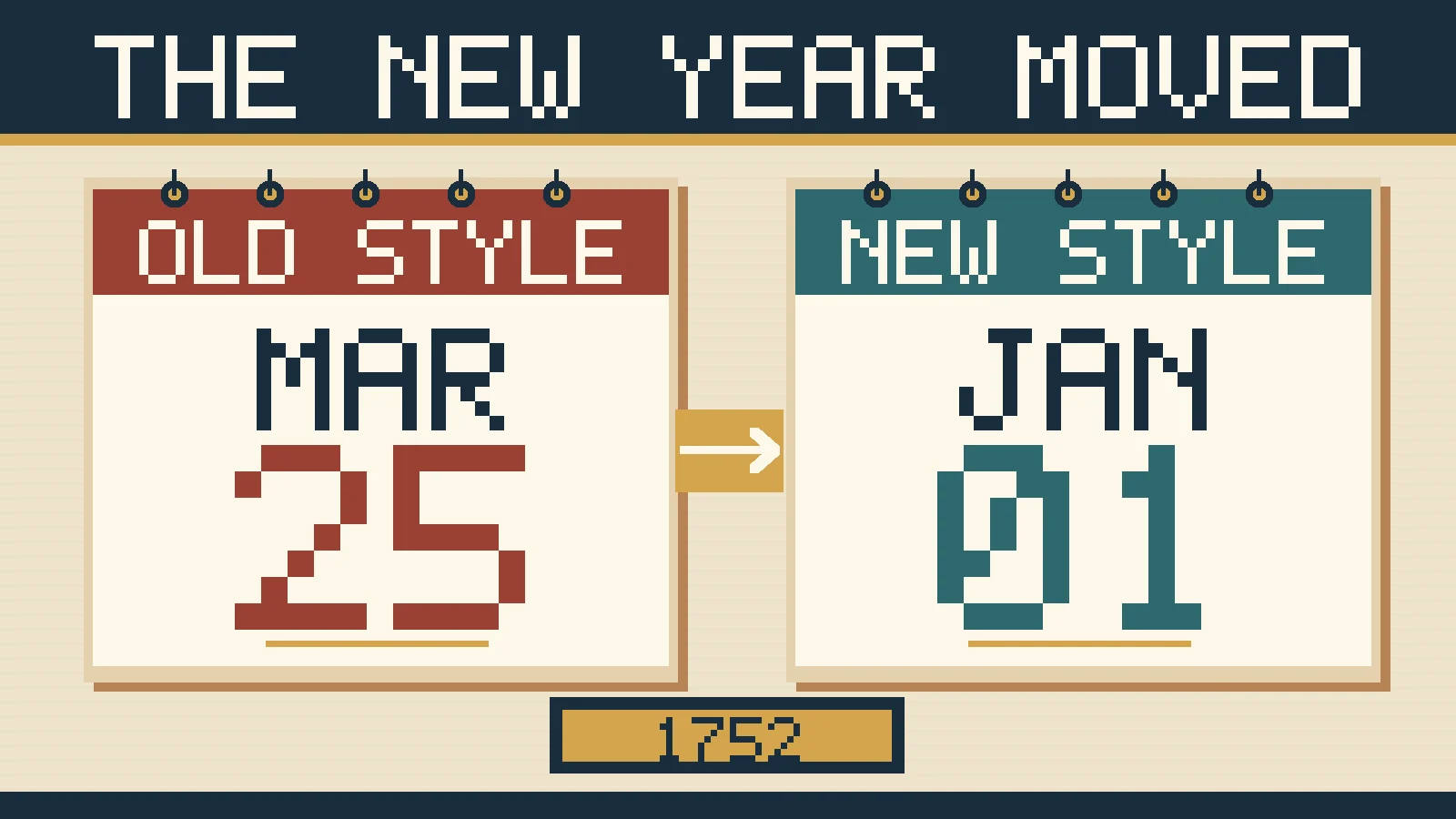
For centuries, a date in January or February could still belong to the previous official year in England. The legal calendar did not turn over on January 1. It turned over on March 25. That made perfect sense to the people keeping the records, and has been giving historians headaches ever since.
England and its American colonies did not formally move the start of the year to January 1 until 1752. The change was written into an actual Act of Parliament, because apparently the calendar needed legislation before everyone could agree what year it was.
Why was March 25 the beginning of the year?
March 25 was Lady Day, the Feast of the Annunciation in the Christian calendar. It also became an important marker for contracts, rents and official records. England adopted the convention of using that date to begin its legal year long before modern standardized calendars.
The UK National Archives’ historical glossary identifies Lady Day as March 25 and notes its role as the beginning of the year under the Julian calendar. The Connecticut State Library’s archival guide explains how the convention spread into England’s North American colonies.
So was January 1 not New Year’s Day?
It could be a celebration even when it was not the official beginning of the numbered year. That is the distinction. As the Connecticut State Library notes, January 1 was increasingly treated as New Year’s Day in everyday usage and almanacs, while government and legal records could still advance the year on March 25.
That left the first few months in a peculiar position. In old-style English legal dating, December 1636 was followed by January 1636, then February 1636. The year number finally changed after March 24. No time machine required; the paperwork was following a different starting line.
Two year numbers could describe the same day
Historians call this double dating. A record might give a date such as March 19, 1631/2, meaning 1631 in the old legal-year reckoning and 1632 in the January-start convention. The slash was not a range of possible years or a guess about when something happened. It was an attempt to make a real date understandable to people using two conventions.
The Connecticut State Library gives examples from its colonial records, including court proceedings that appear out of order until the reader remembers the March 25 rollover. This is why an old diary, parish register or court record can look as though it skipped backward through time.
Parliament changed the year before it changed the dates
The Calendar (New Style) Act 1750, section 1, is unusually direct. It ordered the old practice to end after December 31, 1751, and declared the next day January 1, 1752. That made 1751 an unusually short legal year, running from March 25 through December 31.
The same law handled another problem later that year. Britain’s Julian calendar had drifted eleven days behind the Gregorian system used in much of Europe. So in Britain and its colonies, September 2, 1752 was followed by September 14. Eleven date labels were omitted; people did not actually cease to exist for eleven days.
You can see the change written into the records. A clerk in a Scottish parish register at Inveraray and Glenaray noted that September 3 was now reckoned as September 14, “NS” for New Style. The National Records of Scotland preserves that contemporary explanation. It is one thing to read about eleven missing dates; it is another to see somebody making the adjustment in the parish book.
The two reforms are easy to mix up. Starting the year in January and skipping days in September were separate changes made under the same statute. Scotland had already started its numbered year on January 1 in 1600. National Records of Scotland documents the change in an Edinburgh parish register, with December 1599 followed by January 1600. England retained the March 25 legal-year convention until 1752, so saying all of Britain waited that long would be wrong.
The recordkeeping problem did not vanish with 1752
Anyone reading a colonial-era date still has to ask which convention its writer used. George Washington’s birthday is a famous example of both adjustments: the U.S. National Archives explains that his February 11, 1731 birthday in the old calendar and March 25 year-numbering system becomes February 22, 1732 under the later convention. It is the same birth, not two different birthdays: eleven days of calendar shift plus a one-year change in the year number.
Even modern dates are capable of trouble. If you think the old system sounds confusing, the argument over British and American numeric date order demonstrates that we found a way to keep the calendar interesting.
But the old March 25 New Year makes one thing clear: a date is not just a number on a page. Sometimes you need to know the rules the person writing it was using. Otherwise a perfectly orderly seventeenth-century court clerk can look as if they filed February before last December by mistake.