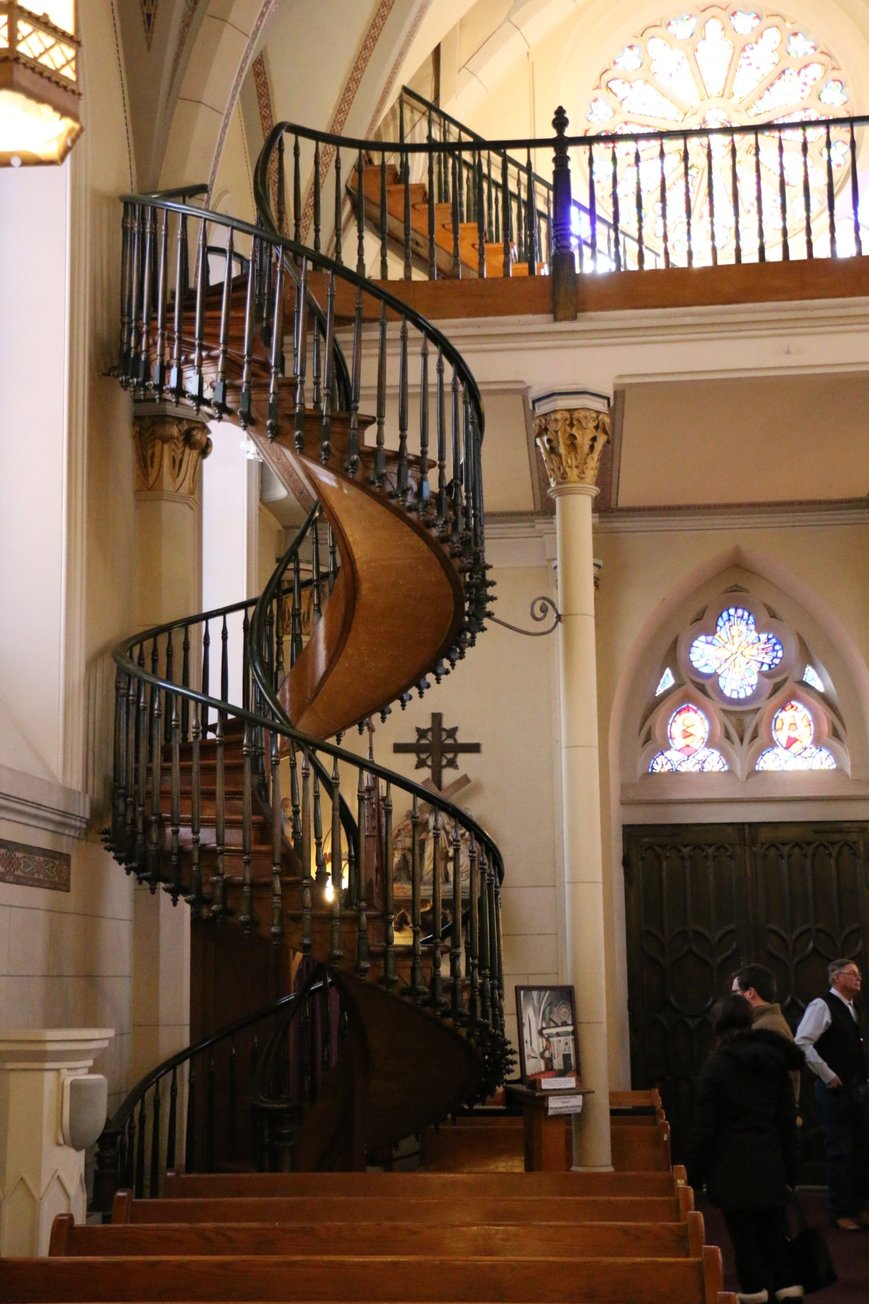


Santa Fe’s Loretto Staircase is famous because a documented piece of 19th-century carpentry became intertwined with a religious legend.
The staircase itself is real, dates to 1878 and is unusual. The story that St. Joseph personally appeared to build it belongs to chapel tradition and faith, while historical research points toward a human carpenter.
What Is the Loretto Staircase?
The staircase stands inside Loretto Chapel in Santa Fe, New Mexico. The National Park Service describes it as a roughly 20-foot circular staircase built to reach the choir loft after the chapel was completed without adequate access.
It makes two full turns, uses wooden pegs instead of ordinary nails, and has no central column. Its structure relies on curved stringers rather than a center support post.
Source: National Park Service: Loretto Chapel.
The Chapel’s Miracle Tradition
According to Loretto Chapel’s own account, the Sisters of Loretto prayed a nine-day novena to St. Joseph, the patron saint of carpenters, after builders said a conventional staircase would take too much space.
The tradition says a carpenter appeared, completed the staircase with simple tools and disappeared without payment. Some people came to believe the carpenter was St. Joseph or had been sent in answer to the sisters’ prayers.
The chapel continues to present this story as part of the staircase’s religious tradition. Loretto Chapel’s staircase history explains that tradition directly.
What Does the Historical Evidence Say?
The National Park Service says recent evidence points to French master carpenter Francois-Jean Rochas as the likely builder. That does not erase the religious meaning the staircase has for believers, but it does mean the builder’s identity should not be described as an unsolved historical mystery with no evidence at all.
Does the Staircase “Defy Physics”?
No reliable source establishes that the staircase violates engineering principles or “defies explanation.” It is an unusual and skillfully built structure.
The absence of a central column makes it visually striking, but the curved stringers provide structural support. The staircase’s engineering is interesting without requiring a claim that ordinary mechanics cannot explain it.
Why the Loretto Staircase Still Fascinates Visitors
The staircase sits at the intersection of architecture, craftsmanship, local history and faith. People can appreciate the documented carpentry and also understand why the chapel’s St. Joseph tradition remains important to many visitors.
The strongest version of the story keeps those two things distinct: the staircase is an extraordinary historic object, and the miraculous-builder account is a religious tradition rather than a settled historical fact.