
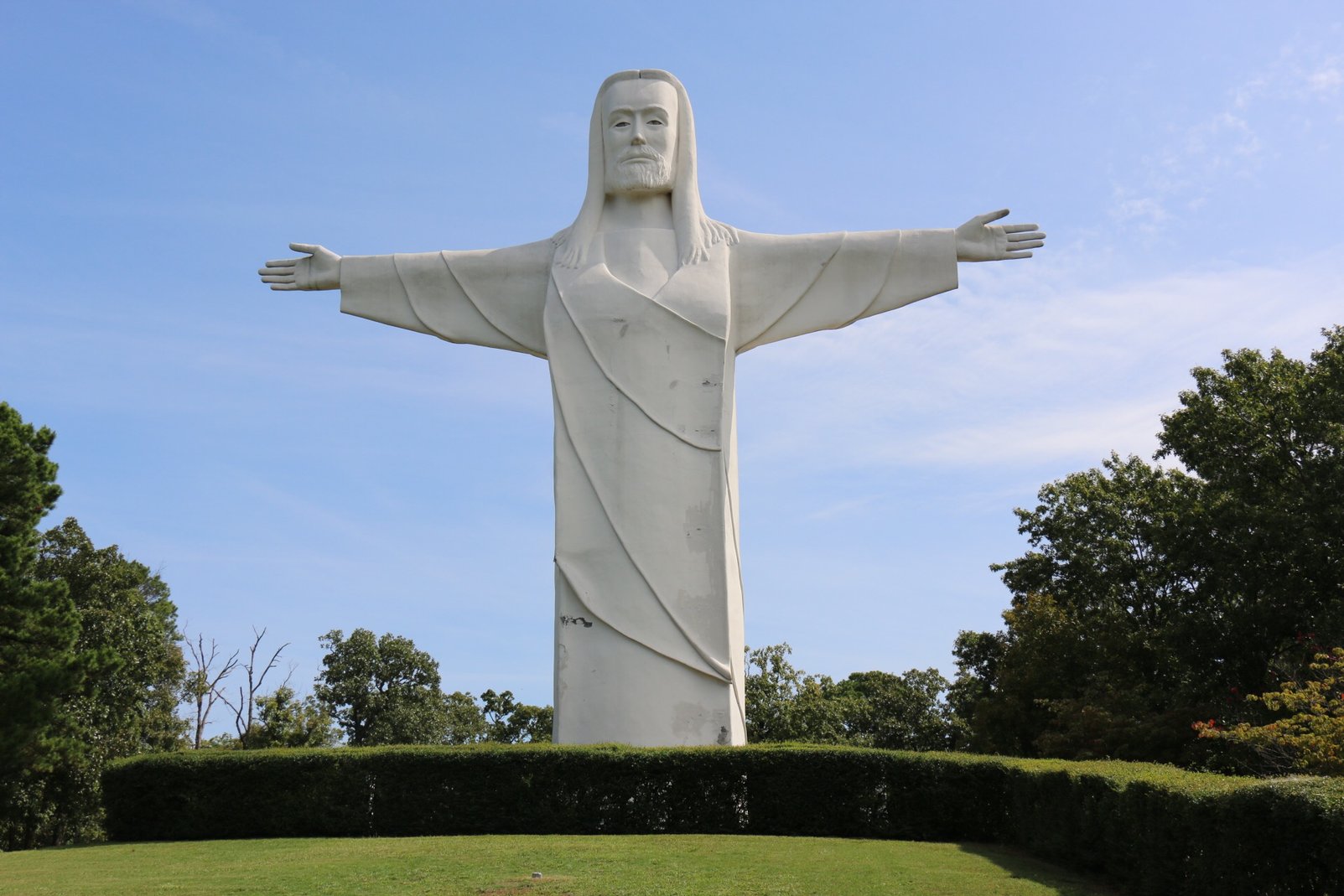

Christ of the Ozarks is a monumental Jesus statue overlooking Eureka Springs, Arkansas, dedicated in 1966 and sculpted by Emmet A. Sullivan.
The statue’s history is inseparable from the religious project that funded it and from Gerald L. K. Smith, the controversial political organizer behind that project.
How Big Is Christ of the Ozarks?
The statue stands about 65.5 feet tall. The Encyclopedia of Arkansas says the completed figure weighs almost two million pounds—about 540 tons.
That total weight is different from the 320 tons of concrete in the foundation. The earlier version of this article blurred those two numbers together.
The Encyclopedia of Arkansas documents the statue’s dimensions, construction and history.
Who Designed the Statue?
Emmet A. Sullivan sculpted Christ of the Ozarks. The figure was constructed by hand with a steel frame and multiple layers of white mortar.
Its outstretched arms span roughly 65 feet and suggest the form of a cross even though the statue does not depict a physical cross behind the figure.
When Was It Dedicated?
The statue was dedicated on June 25, 1966. Work on some of the robe details continued for several weeks afterward.
What Is the 500-MPH Wind Claim?
The Encyclopedia of Arkansas reports that the statue was designed to withstand winds of 500 miles per hour. That is a documented design claim associated with the structure—not a claim that a 500-mph storm has ever tested it.
The same source notes a pressure-equalization opening in the top of the head intended to reduce tornado-related pressure effects.
Gerald L. K. Smith and the Statue’s Controversial History
The statue was funded through the Elna M. Smith Foundation as part of what Smith called his “Sacred Projects.”
The Encyclopedia of Arkansas describes Gerald L. K. Smith as an antisemitic minister and political agitator. His record included extremist political activity and antisemitic rhetoric. That history is relevant to the site and should be described directly rather than softened into a vague reference to “controversy.”
Why the Statue Still Draws Attention
For visitors, Christ of the Ozarks can function simultaneously as a religious landmark, a large-scale work of roadside architecture and a site connected to a difficult political history.
Its unusual proportions and stark design have also attracted nicknames and online commentary over the years, but those reactions are secondary to the documented history of the statue itself.