
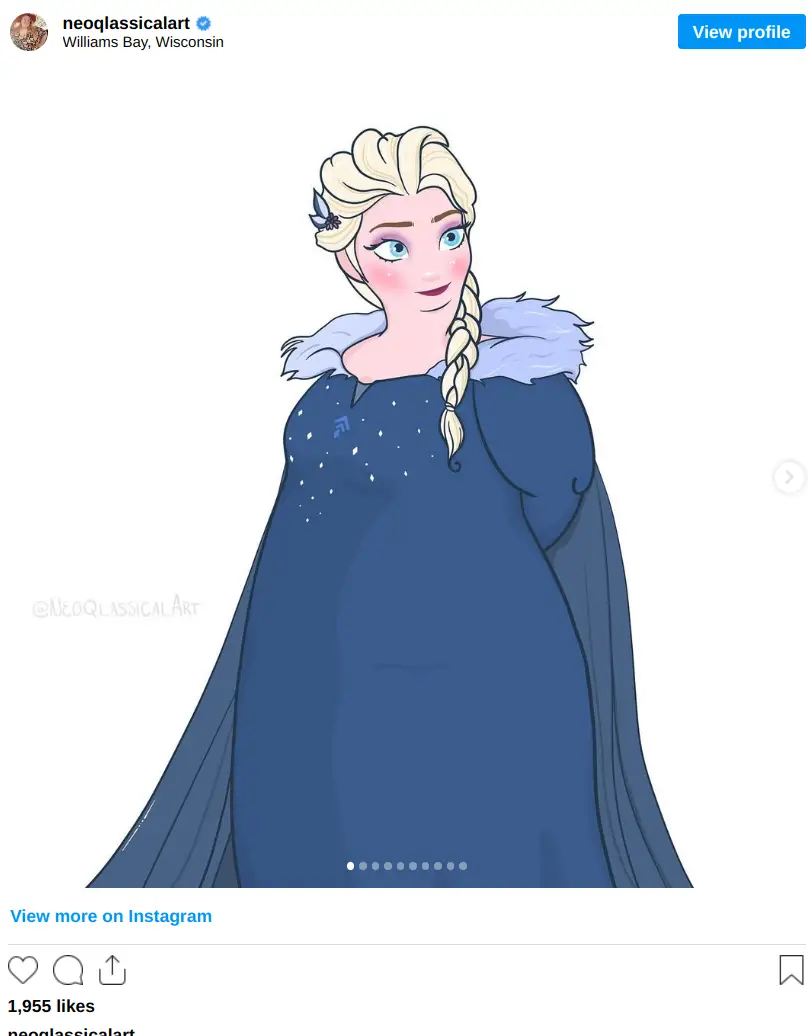

Artist Crystal Walter, known online as Neoqlassical Art, reimagined familiar Disney characters in larger bodies as a representation project.
The point of the work was not to claim that one body type is more “realistic” than another. Walter has explained that she wanted people with larger bodies to be able to see themselves in characters they already loved.
Crystal Walter’s Project Was About Representation
In a 2020 interview with Bored Panda, Walter said she grew up without positive fat role models in media and wanted to create images that offered a different kind of representation.
Bored Panda’s interview with Crystal Walter documents her motivation and the public reaction to the project.
The Earlier “70%” Statistic Needed More Context
The previous version of this article leaned heavily on an older statistic saying roughly 70% of U.S. women were “plus-sized.” That figure came from a specific fashion-market definition and a 2017 article, so it should not be treated as a timeless population fact.
Walter’s own explanation is stronger than that statistic anyway. Her stated goal was representation: drawing larger bodies in roles that popular media had rarely shown that way.
The Art Included Princesses, Princes and Other Characters
Walter reworked characters including Elsa, Cinderella, Ariel, Belle, Merida and others. She also drew male characters in larger bodies.
The images attracted praise from people who said they appreciated the representation and criticism from people who interpreted the work as making a health statement. Walter rejected that framing and said her project was about the equal worth and visibility of people in larger bodies.
Why the Project Drew Attention
Disney characters are culturally familiar, which made the changes immediately noticeable. Walter used that familiarity to ask a straightforward representation question: what happens when characters usually drawn with extremely narrow body proportions are imagined differently?
The result became widely shared because viewers recognized both the characters and the broader conversation about who gets represented positively in popular media.